
SINCE 2004
LiveReader
We research and develop AI technologies that support people rather than replace them.
20 years of LiveReader GmbH - innovation, trust and growth
Twenty years of ideas, challenges and success stories. Since its foundation in 2004, LiveReader has developed into a company based on research, innovation and a clear set of values. We are proud of our history and equally excited about the future.
When LiveReader was founded 20 years ago, there was only a vision and a handful of people who believed in it. It started in a small office, with an idea and a determination to help shape the future. Two decades later, we look back and see not just a company, but a vibrant network of partners, customers and employees who have created something bigger together.
The earlier logos turn into today's marks — the LiveReader shield, the Alternis A, the Notitia cube — and in the end all three stand side by side.
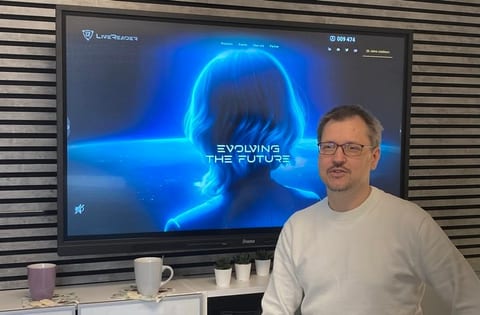
Interview with Managing Director Dr. Eric Rietzke
Dr. Rietzke, you were there from day one when LiveReader was founded in 2004. What was your greatest motivation back then?
For me, it was always the urge to create something new that would last. I didn't just want to found a company, but a platform that would bring progress and innovation to the world and always respond to people's needs. I still remember well how we came up with the name LiveReader in a small group. The beginnings of our company history lie in the blind and visually impaired sector. LiveReader's first innovation at the time was a reading device. Blind people could place their everyday mail on a surface - like a kind of printer - and have the content read aloud by voice output. Invoices, doctor's letters, contracts - everything that flutters through the letterbox every day was possible. Our company name was derived from this: LiveReader - English "Live" and "Reader" stand for "to read something out in real time".
You have remained true to the meaning of your company name to this day. Your AI technologies also read something out loud. How did LiveReader come to be an AI research company today?
Just as everyone evolves and changes with the times, so it is with companies. When I was studying computer science at Trier University of Applied Sciences in the mid-90s, the Internet was not yet public. At some point, I had my first e-mail address. What is everyday life for my sons today was already progress at the turn of the millennium. LiveReader has followed all the steps. There were, of course, milestones in the company's history that steered us in a new direction. Above all, it is the research projects that always provide new impetus for our innovations.
Do you have a guiding principle for constantly adapting the company to new challenges?
There is a thought that stays with me: "Time changes us and we change time." For me, this means that we as a company must constantly learn and adapt. But this change is not a one-way street. The experience we gain and the innovations that arise from it flow back into society and help shape it. It is a cycle in which we as a company not only react, but also provide impetus that will hopefully have a positive impact.
You say "hopefully"? Do you have any concerns when you think about the future with AI?
Yes and no! We at LiveReader develop AI assistance systems. I have no concerns about that. Figuratively speaking, we deliberately place a kind of crash barrier in front of our technologies so that they don't leave the road. Most people will know from ChatGPT, as the best-known representative, that creativity can sometimes run away with AI (laughs). It's up to us developers to make sure that humans have a reliable tool at their disposal.
My concerns relate more to the development of our children - in terms of global society. We humans are capable of peak performance if we have had the opportunity to learn things from an early age. But that takes time and the process to go through. I'm worried that this developmental step could be neglected in the future. Time has moved fast and there is a huge pool of knowledge available in the digital world. As humanity, we must not make the mistake of limiting our natural intelligence and letting artificial intelligence take the lead.
AI as a tool: a resounding YES.
AI as a substitute for our own knowledge: A clear NO.
You say "AI as a tool". What do you mean by that?
Let's think back to when people only had shovels and not yet excavators. It took 20 - 30 people to dig a construction pit. Today, you can do it with one excavator operator. And yes - the other workers were probably afraid that the new innovation - excavators - would put them out of work. But that wasn't the case: instead, new professions developed, people gained qualifications and developed further. The excavator did not destroy jobs, but rather created new ones. Now much more was possible in less time.
That's exactly how I see it with artificial intelligence. It can memorize a huge amount of data, much more than we humans ever could. It analyzes at lightning speed and can point out conflicting goals.
I see AI in collaboration with humans as an unbeatable team. Not AI alone - not humans alone either.
But if you combine the best of both worlds, only then can innovation become progress.
In your opinion, what is the biggest advantage of technological change?
Well, let's take a look at social change. A lot of knowledge and experience will be retiring in the next few years. The term "skills shortage" is often used to describe what we lack. I see a good approach here: we can make use of AI by digitally storing all the knowledge and experience of this generation. Younger, less experienced colleagues could learn from this instead of losing their know-how to the labor market when they retire. AI will not replace jobs - but AI can help to ensure that we can still work effectively in a shortage situation.
When you look to the future, what is your vision for the next 20 years?
I see a world where innovation will connect us even more, and we are working to continue to be a part of it. Our team focuses every day on developing AI technologies that not only stand for growth, but first and foremost have real added value - for people, for society.
"In a world that is constantly turning, adaptation is a firm anchor." - Dr. Eric Rietzke
Research is our foundation
Above all, it is our research projects that continually spark new impulses for our innovations — independently audited and confirmed. Our research page shows how this research becomes our technologies.