
RESEARCH AND DEVELOPMENT
From research to product
Alternis, Notitia and Nova are not products first — they are the result of more than two decades of independent research. Since 2004, we have been investigating how artificial intelligence can genuinely support people, feeding every insight back into our technologies.
What we research
Language research
How machines can not only recognize spoken language but understand it — regardless of language, accent or background noise. The foundation of Alternis.
Knowledge representation
How expertise can be modelled so that an AI applies it transparently, rather than merely guessing. The foundation of Notitia.
Human-AI collaboration
How AI systems can be designed so that humans retain control and responsibility stays where it belongs. The foundation of Nova.
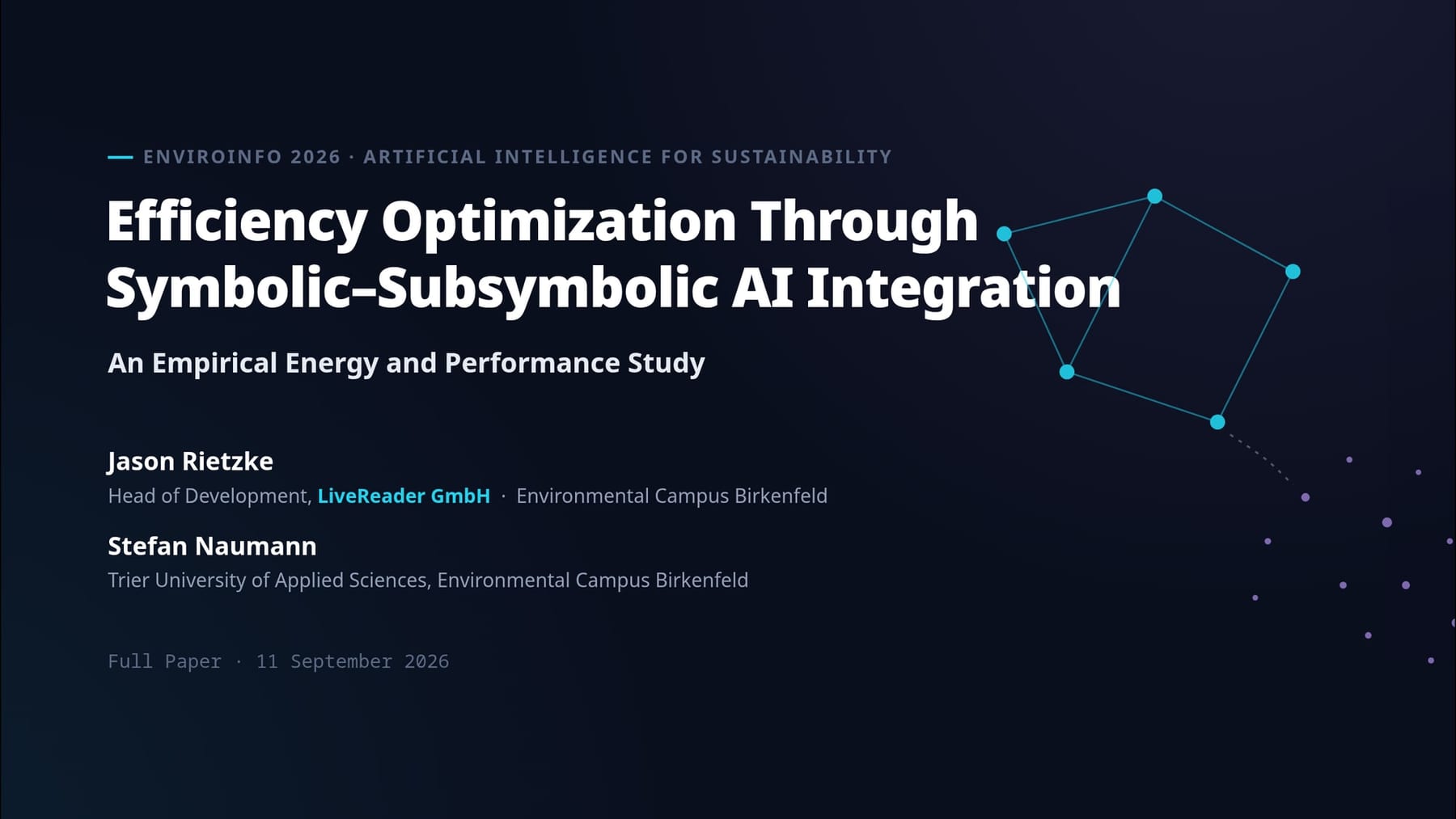
EnviroInfo 2026: Energy efficiency through hybrid AI
Presented as a full paper at the 40th International Symposium on Environmental Informatics (EnviroInfo 2026) in Łódź; the full version is to appear in the Springer book series “Progress in IS – Advances in Environmental Informatics”. Jason Rietzke (LiveReader GmbH) and Stefan Naumann (Trier University of Applied Sciences, Environmental Campus Birkenfeld) measured what it costs in energy to let a language model run a process that a rule-based system already knows.
For a realistic workflow they used the ANA emergency-call protocol from the SPELL research project — a semantic network of some 7,800 nodes. One identically scripted emergency call was run 30 times per strategy on the same hardware: once driven entirely by the language model, once with the model as a pure extractor, while Notitia's symbolic process control decides which question comes next. Energy consumption was measured per dialogue turn at the GPU's hardware counter, not estimated.
The hybrid approach took 71.5 seconds instead of 547.6 (factor 7.7) and 3.25 watt-hours instead of 28.92 (factor 8.9). The gain breaks down into two factors that multiply: 1.87 times fewer turns, because the rule set navigates deterministically, and 4.75 times cheaper turns, because the prompt needs no history and no state. The symbolic share itself carries no energetic weight — it comes in around 2,200 times below a single GPU step. Extrapolated to 1,000 emergency calls a day, that is some 2.3 tonnes of CO₂ equivalent a year, from an architectural decision alone.
"AI as a tool: a clear yes. AI as a replacement for one's own knowledge: a clear no." — Dr. Eric Rietzke, Managing Director
Publications
Our research is published in the open. All papers are freely accessible unless otherwise indicated.
2026
Efficiency Optimization Through Symbolic–Subsymbolic AI Integration: An Empirical Energy and Performance StudyRietzke, J.; Naumann, S.
Conference paperEnviroInfo 2026, Łódź · Springer: Progress in IS – Advances in Environmental Informatics Open Access
2025
Hybrides wissensbasiertes Reasoning für wissensintensive Prozesse am Beispiel von NotrufabfragenRietzke, E.; Maletzki, C.; Grumbach, L.; Bergmann, R.
Book chapterHybride KI mit Machine Learning und Knowledge Graphs, Springer Vieweg, S. 297–318 Open Access
2024
Towards Human-AI Interaction in Medical Emergency Call HandlingMaletzki, C.; Elsenbast, C.; Reuter-Oppermann, M.
Conference paper57th Hawaii International Conference on System Sciences (HICSS) Open Access
2024
Empowering Large Language Models in Hybrid Intelligence Systems Through Data-Centric Process ModelsMaletzki, C.; Rietzke, E.; Bergmann, R.
Conference paperAAAI Spring Symposium MAKE 2024, Stanford University Open Access
2024
KI-gestützte Kommunikation in Notrufgesprächen (Alternis)Maletzki, C.; Rietzke, E.; Elsenbast, C.; Reuter-Oppermann, M.
AbstractForum Rettungswissenschaften Open Access
2024
KI-gestützte Adaptive Notrufabfrage (KIANA)Maletzki, C.; Blaschke, F.; Hippler, B.
AbstractForum Rettungswissenschaften Open Access
2023
Towards Hybrid Intelligent Support Systems for Emergency Call HandlingMaletzki, C.; Grumbach, L.; Rietzke, E.; Bergmann, R.
Conference paperAAAI Spring Symposium MAKE 2023, San Francisco · CEUR Workshop Proceedings Open Access
2023
Interdisziplinäres Lagebild in Echtzeit – GrünbuchZukunftsforum Öffentliche Sicherheit e.V. (ZOES); Rietzke, E. als Mitwirkender
Book chapterZukunftsforum Öffentliche Sicherheit e.V. (ZOES) Open Access
2023
Implikationen von Mental Pictures in der Mensch-Computer Interaktion zur Entscheidungsunterstützung während der Notrufbearbeitung in Integrierten LeitstellenElsenbast, C.; Maletzki, C.; Reuter-Oppermann, M.
AbstractForum Rettungswissenschaften Open Access
2022
SPELL – Intelligente Systeme zur EinsatzunterstützungRietzke, E.; Elsenbast, C.
AbstractForum Rettungswissenschaften Open Access
2022
Utilizing Expert Knowledge to Support Medical Emergency Call HandlingMaletzki, C.; Rietzke, E.; Bergmann, R.
Workshop paperFCR@KI 2022 (KI 2022) · CEUR Workshop Proceedings Open Access
2021
Modellierung, Visualisierung und Ausführung wissensintensiver Prozesse unter Verwendung Semantischer TechnologienRietzke, E.
PhD thesisUniversität Trier (OPUS) Open Access
2021
Execution of Knowledge-Intensive Processes by Utilizing Ontology-Based Reasoning (ODD-BP)Rietzke, E.; Maletzki, C.; Bergmann, R.; Kuhn, N.
Journal articleJournal on Data Semantics, Vol. 10, S. 3–18 Open Access
2019
ODD-BP – An Ontology- and Data-Driven Business Process ModelRietzke, E.; Bergmann, R.; Kuhn, N.
Conference paperLWDA 2019 · CEUR Workshop Proceedings Open Access
2019
Utilizing Ontology-Based Reasoning to Support the Execution of Knowledge-Intensive ProcessesMaletzki, C.; Rietzke, E.; Grumbach, L.; Bergmann, R.; Kuhn, N.
Conference paperBPM 2019, Workshop AI4BPM · Springer
2018
SEMANAS – Semantic Support for Grant Application ProcessesGrumbach, L.; Rietzke, E.; Schwinn, M.; Bergmann, R. et al.
Conference paperLWDA 2018 · CEUR Workshop Proceedings Open Access
2017
Adaptive Business Process Visualization for a Data and Constraint-Based Workflow ApproachRietzke, E.; Bergmann, R.; Kuhn, N.
Conference paperLWDA 2017 · CEUR Workshop Proceedings Open Access
2017
Semantically-Oriented Business Process Visualization for a Data and Constraint-Based Workflow ApproachRietzke, E.; Bergmann, R.; Kuhn, N.
Conference paperBPM 2017, Workshop AI4BPM · Springer
2016
SEMAFLEX – Semantic Integration of Flexible Workflow and Document ManagementGrumbach, L.; Rietzke, E.; Schwinn, M.; Bergmann, R.; Kuhn, N.
Conference paperLWDA 2016 · CEUR Workshop Proceedings Open Access
Independently verified
Our research and development expertise is not self-proclaimed. It has been audited by an independent body, and this work has produced research projects of our own, whose results flow back into our products.
We have a close, strategic research partnership with the Deutsches Forschungszentrum für Künstliche Intelligenz (DFKI), the German Research Center for Artificial Intelligence: our managing director, Dr. Eric Rietzke, is himself a researcher at the DFKI, results flow directly into our products, and our technologies are put to practical use in DFKI projects.
Our company was recognized for its independent research and development expertise.

We were a research partner in the renowned R&D project SPELL
We are an IHK-registered training company
Research with us
Are you working on similar questions, or considering how research and development could benefit your company? We welcome research partnerships and exchange with universities, institutes and other companies.